
The Daily Telegraph reported on 10 August 2026 that 16 of 26 Sydney Metro and train Park&Ride locations it checked on one recent Thursday were full by 9am. That is a useful snapshot, but one morning cannot show whether the result was normal.
Not a direct like-for-like comparison: the newspaper checked 26 Metro and train locations and described car parks as full. ParkRide Planner's study covers 39 Metro, train, regional and bus-linked car parks and uses a sustained, capacity-adjusted practically full threshold. We could not confirm the newspaper's exact Thursday or complete list, so the two figures should not be treated as the same measurement.
What the newspaper found
The Telegraph said another eight of the 26 checked locations had less than 50 per cent vacancy. It named Emu Plains, Kiama and Warwick Farm among the relatively available locations, while reporting that Ashfield filled before about 7:40am, Hornsby was close to full around 10am, and Gosford was under pressure.
Those observations come from the newspaper. We could not find a primary source for its exact sample date or full list of 26 car parks. We also left out claims about government-wide parking totals because their meaning could not be verified from a primary NSW Government or Transport for NSW source.
What 12 weeks of parking history show
ParkRide Planner analysed normal-term weekdays from to . Across 36 weekdays with broad coverage, the median morning had 25 of the 39 car parks practically full by 9am. The daily count ranged from 11 to 27.
Looking at each car park separately, 26 of 39 were practically full by 9am on at least half their valid weekdays. Five usually crossed the threshold before 7am, another 12 between 7am and 8am, and nine between 8am and 9am.
Car parks practically full by 9am
Median count across the 39 car parks in this analysis. Wednesday's median falls between 26 and 27.
When car parks usually get tight
- Before 7am
- 5
- 7–8am
- 12
- 8–9am
- 9
- Mixed
- 1
- Usually available
- 12
The bands use each car park's valid normal-term weekdays. “Usually available” means it did not become practically full by noon on at least half those days.
Tuesday to Thursday were tightest
The median number practically full by 9am was 26 on Tuesday, 26.5 on Wednesday and 25 on Thursday.
Friday was much quieter
The Friday median was 13 car parks practically full by 9am, compared with 21 on Monday.
Some car parks filled very early
Tallawong P1 and P2, Cherrybrook and both monitored Campbelltown car parks were practically full before 7am on most valid weekdays.
Thirteen usually lasted beyond 9am
Gosford was mixed. Twelve others usually remained below the practical-full threshold through the morning sample.
When the 39 car parks usually became tight
The table groups each car park by the earliest time when it was practically full on at least half its valid normal-term weekdays. “Usually available” means it did not become practically full by noon on at least half the valid days. Gosford is marked mixed because it filled by noon on most valid days, but before 9am on only 35 per cent.
Swipe across to see percentages and median 9am spaces.
| Car park | Typical band | Full by 9am | Median spaces at 9am | Valid days |
|---|---|---|---|---|
| Tallawong P1 | Before 7 | 100% | 0 | 48 |
| Campbelltown Hurley St | Before 7 | 100% | 1 | 49 |
| Tallawong P2 | Before 7 | 100% | 0 | 48 |
| Cherrybrook | Before 7 | 100% | 0 | 48 |
| Campbelltown Farrow Rd (north) | Before 7 | 96% | 0 | 49 |
| Brookvale* | 7-8am | 100% | 0 | 37 |
| West Ryde* | 7-8am | 100% | 0 | 49 |
| Gordon Henry St (north)* | 7-8am | 100% | 0 | 46 |
| Tallawong P3 | 7-8am | 98% | 0 | 48 |
| Ashfield* | 7-8am | 96% | 0 | 49 |
| Hornsby | 7-8am | 94% | 0 | 49 |
| Hills Showground | 7-8am | 92% | 0 | 48 |
| Lindfield Village Green | 7-8am | 90% | 0 | 49 |
| Narrabeen* | 7-8am | 87% | 0 | 38 |
| Manly Vale* | 7-8am | 82% | 0 | 38 |
| Mona Vale* | 7-8am | 81% | 0 | 31 |
| Kogarah | 7-8am | 78% | 3 | 49 |
| Schofields | 8-9am | 76% | 0 | 49 |
| North Rocks* | 8-9am | 76% | 0 | 49 |
| Kellyville (south) | 8-9am | 75% | 0 | 48 |
| Bella Vista | 8-9am | 71% | 0 | 48 |
| Dee Why* | 8-9am | 66% | 12 | 38 |
| Sutherland* | 8-9am | 65% | 5 | 46 |
| Warriewood* | 8-9am | 60% | 6 | 35 |
| Kellyville (north) | 8-9am | 56% | 6 | 48 |
| Riverwood | 8-9am | 53% | 16 | 49 |
| Gosford | Mixed | 35% | 89 | 49 |
| Kiama | Usually available | 4% | 35 | 49 |
| Revesby | Usually available | 0% | 160 | 49 |
| Penrith (at-grade) | Usually available | 0% | 92 | 49 |
| Edmondson Park (south) | Usually available | 0% | 384 | 49 |
| Leppington | Usually available | 0% | 394 | 49 |
| Beverly Hills | Usually available | 0% | 118 | 49 |
| Edmondson Park (north) | Usually available | 0% | 769 | 49 |
| Emu Plains | Usually available | 0% | 688 | 49 |
| Penrith (multi-level) | Usually available | 0% | 434 | 49 |
| Seven Hills | Usually available | 0% | 755 | 49 |
| St Marys | Usually available | 0% | 245 | 49 |
| Warwick Farm | Usually available | 0% | 443 | 49 |
*Partial 12-week coverage or fewer than 45 usable 9am readings. Percentages use that car park's valid normal-term days and should be read with extra caution.
How the named locations compare
The six named locations split into three different patterns. Ashfield and Hornsby were consistently early. Gosford varied. Emu Plains, Kiama and Warwick Farm usually retained useful capacity at 9am.
Swipe across to compare the six locations.
| Car park | Practically full by 9am | Median full time* | Median spaces at 9am | 12-week reading |
|---|---|---|---|---|
| Ashfield | 96% of 49 days | 7:26am | 0 | Usually constrained well before 9am |
| Hornsby | 94% of 49 days | 7:21am | 0 | Usually constrained well before 9am |
| Gosford | 35% of 49 days | 8:41am | 89 | Mixed; pressure varies a lot by day |
| Kiama | 4% of 49 days | Too few full days | 35 of 42 | Usually had plenty of space |
| Emu Plains | 0% of 49 days | Did not fill | 688 of 750 | Usually had plenty of space |
| Warwick Farm | 0% of 49 days | Did not fill | 443 of 906 | Usually retained useful capacity |
*Median practical-full time is calculated only among valid days that became practically full by noon. It is not meaningful for Kiama, which crossed the threshold on only two valid days.
The 12-week data supports the newspaper's broad distinction between Ashfield and the car parks with more room. Hornsby's past pattern was earlier than a “close to full around 10am” description, but the newspaper may have used exact zero rather than ParkRide Planner's practical threshold. Gosford does not follow one simple rule: it was practically full by noon on 59 per cent of valid days, but by 9am on only 35 per cent.
Was that Thursday typical?
Across the 39 car parks in this analysis, the seven comparable Thursdays had 23 to 27 car parks practically full by 9am, with a median of 25. A Thursday with widespread parking pressure was not unusual in this window.
That does not prove the newspaper's 16-of-26 result was exactly typical. Its group of car parks was narrower, its definition appears different, and neither the exact Thursday nor the full list could be confirmed. The fair conclusion is that the newspaper captured a recurring problem, but the answer still depends on the car park.
What this means for commuters
- Do not use one Sydney-wide cut-off. Tallawong and Cherrybrook can be tight while some western and south-western car parks still have plenty of space.
- Treat Tuesday to Thursday as the tighter part of the week. Friday left many more options in this 12-week window.
- Use live availability for the final decision. Historical percentages describe recent patterns, not today's remaining spaces.
- Compare nearby alternatives before driving. Two nearby car parks can differ by hundreds of spaces at the same time.
Turn the network pattern into your own plan
Check the weekday and arrival time you actually use.
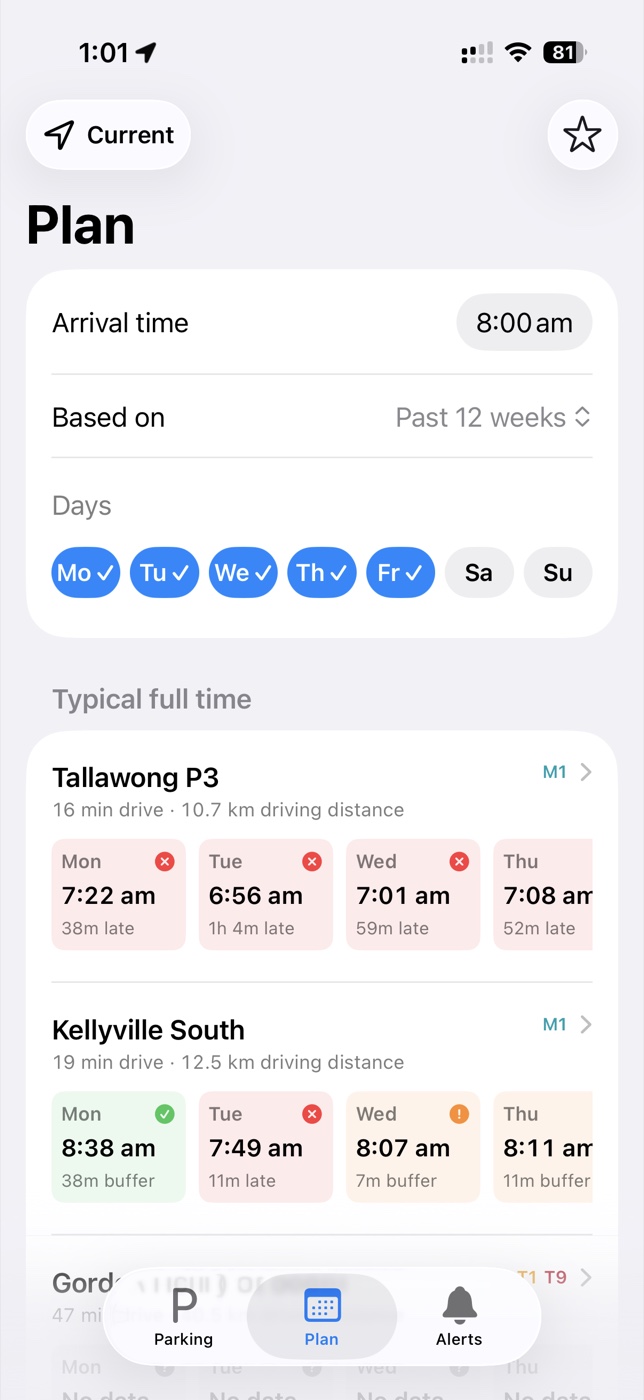
This article shows the broad network. In ParkRide Planner, the Plan tab applies the same 12-week normal-term approach to your selected car parks and usual arrival time, then the live Parking tab shows what is happening today.
The practical answer
Many car parks do fill before 9am. Not all of them do.
The 12-week history shows where an early arrival is usually essential and where useful capacity has normally remained.
For weekday variation, see which day is usually busiest for Sydney Park & Ride. For future capacity, see the Tallawong expansion analysis.
Method, limits and sources
Analysis window: 19 May to 10 August 2026, covering the app's main 12-week period. The analysis uses completed weekdays and excludes NSW public holidays and school holidays. Each car park has 31 to 49 valid days. For six Northern Beaches car parks, 18 June to 2 July is also excluded because Transport for NSW advised that boom gates would remain open during industrial action.
A car park is practically full when availability stays below ParkRide Planner's capacity-adjusted threshold for long enough to show that parking is tight. It is not the same as one zero-space reading. The app and this analysis use the same method.
The source is the Transport for NSW Car Park API. ParkRide Planner stores up to one reading per car park per Sydney-local minute and does not invent values to fill gaps. A day is included only when it has at least 60 readings and data through noon. The 9am result uses the nearest quality-checked reading from the five minutes up to 9am.
Transport for NSW describes occupancy as estimated. Counts can drift, repeat or reset because of equipment or data issues. ParkRide Planner checks for unreliable counters, but the results still cover monitored official car parks rather than surrounding street parking. Use the official Transport Park&Ride page for access rules and eligibility for up to 18 hours of free parking.
Sources
- Daily Telegraph, “Sydney Park'n'Ride crisis: How bad it really is at your station”, 10 August 2026 (secondary reporting; paywalled).
- Transport for NSW, Transport Park&Ride car parks.
- Transport for NSW Open Data, Car Park API.
- ParkRide Planner article dataset, generated from production history with a reproducible read-only analysis script.
ParkRide Planner is an independent iPhone and Apple Watch app using publicly available Transport for NSW data. It is not affiliated with or endorsed by Transport for NSW.