
Have you ever wondered whether people commute less when it rains? We did. On one wet Sydney morning, the parking curves in ParkRide Planner looked suspiciously ordinary. Across the Metro, they were falling at almost exactly their usual weekday pace.
One morning is not an analysis, so we put the question to 12 weeks of parking and rainfall data.
Short answer: a rainy morning might delay the point when some car parks become practically full, but it did not leave useful extra capacity at 8am or 9am. Rain is not a reliable reason to leave home later.
The tempting theory
The theory sounds reasonable. Rain could mean more people work from home, take a different mode, or abandon a discretionary trip. Fewer drivers should then mean station parking fills more slowly.
There is one small problem: people still need to get to work. Rain can also make walking, cycling or waiting for a feeder bus less attractive. The net effect could go either way, so we did not assume a direction before looking at the numbers.
What the numbers show
After matching rainy and dry mornings within the same station and weekday, the difference in actual capacity was close to zero. At 8am, rainy mornings had an estimated 1.2 percentage points less capacity. At 9am, the difference was 0.2 percentage points less.
Neither result shows a reliable effect from rain. More importantly for commuters, neither suggests that rain leaves more parking available.
Capacity remaining
Right means more parking remained on rainy mornings. Left means less.
Practical-full time, among station-days that filled
Right means the practical-full threshold was reached later.
The uncertainty ranges all include no effect. The data are compatible with a modest delay, but not with a claim that rain reliably changes parking behaviour.
| Measure | Rainy effect | 95% range | Practical reading |
|---|---|---|---|
| Capacity at 8am | -1.2 pp | -2.5 to +0.1 pp | No extra capacity |
| Capacity at 9am | -0.2 pp | -1.6 to +1.2 pp | Effectively no difference |
| Practical-full time | +15 min | -0.5 to +31 min | Possible delay; uncertain |
| Practically full by 9am | -13 pp | -30 to +4 pp | Fewer threshold crossings; uncertain |
How can the full time change if the number of spaces does not?
This is the most useful part of the result. A car park can sit just above ParkRide Planner's practical-full threshold with only a small number of spaces left. Rain might slow arrivals enough to postpone crossing that line, without leaving enough extra capacity to change a commuter's decision.
That is why we checked both outcomes. Looking only at “full by 9am” would suggest a larger rainy-day benefit. Looking at the actual share of spaces remaining shows that the practical difference was close to zero.
The Northwest Metro result was even clearer
We repeated the comparison for Tallawong, Kellyville, Bella Vista, Hills Showground and Cherrybrook. These five stations contributed 232 station-days, including 30 rainy station-days.
The estimated fill-time range ran from 10 minutes earlier to 24 minutes later, so seven minutes is not a reliable allowance. The capacity result is more useful: rainy and dry mornings looked almost the same by the times most commuters care about.
Rain did not affect every station the same way
We also looked at 55 station-and-weekday comparisons with at least two rainy and five dry mornings. We treated a difference within two percentage points at 8am as little practical difference.
The median comparison was 0.7 percentage points less capacity on rainy mornings. There was no consistent station-level pattern that commuters could sensibly use as a rule.
How we tested it
The primary window covers 12 complete workweeks from to . It contains 1,421 usable station-days across 32 stations: 179 rainy and 1,242 dry.
- Rainy morning: at least 1mm of modelled precipitation between 4am and 9am at the station location.
- Dry morning: no more than 0.1mm over the same period. Intermediate mornings were left out of the main comparison.
- Parking results: quality-checked Transport for NSW readings were grouped by station and day, so Tallawong's three car parks count as one station rather than three votes.
- Controls: rainy and dry results were compared within the same station and weekday.
- Uncertainty: 2,000 bootstrap samples were clustered by date, because one weather system can affect many stations at once.
NSW public holidays and school holidays were excluded. Northern Beaches car parks were left out during the known June and July boom-gate industrial-action period. Gordon was excluded because Gordon South was added during the final week, changing the station's monitored capacity.
The result was stable when the rain threshold moved from light rain to heavier rain. A longer 20-week sensitivity check also found no evidence of extra 8am capacity on rainy mornings. We kept the denser, more consistent 12-week window as the primary result.
Limitations: this comparison cannot prove cause and effect. Rainfall comes from a historical weather model rather than a gauge inside each car park. There were 12 dates with rain at one or more stations in the main sample, so a small effect remains possible. Transport for NSW sensor counts can also occasionally drift or be corrected.
What this means before your next wet commute
Rain might shift the practical-full timestamp by a few minutes. It did not reliably leave more spaces at 8am or 9am, including at the Northwest Metro stations that prompted this analysis.
So the useful rule is simple: do not assume rain buys extra parking time. Check the live count and today's pace just as you would on a dry morning.
Check today's conditions
Weather is not a parking forecast.
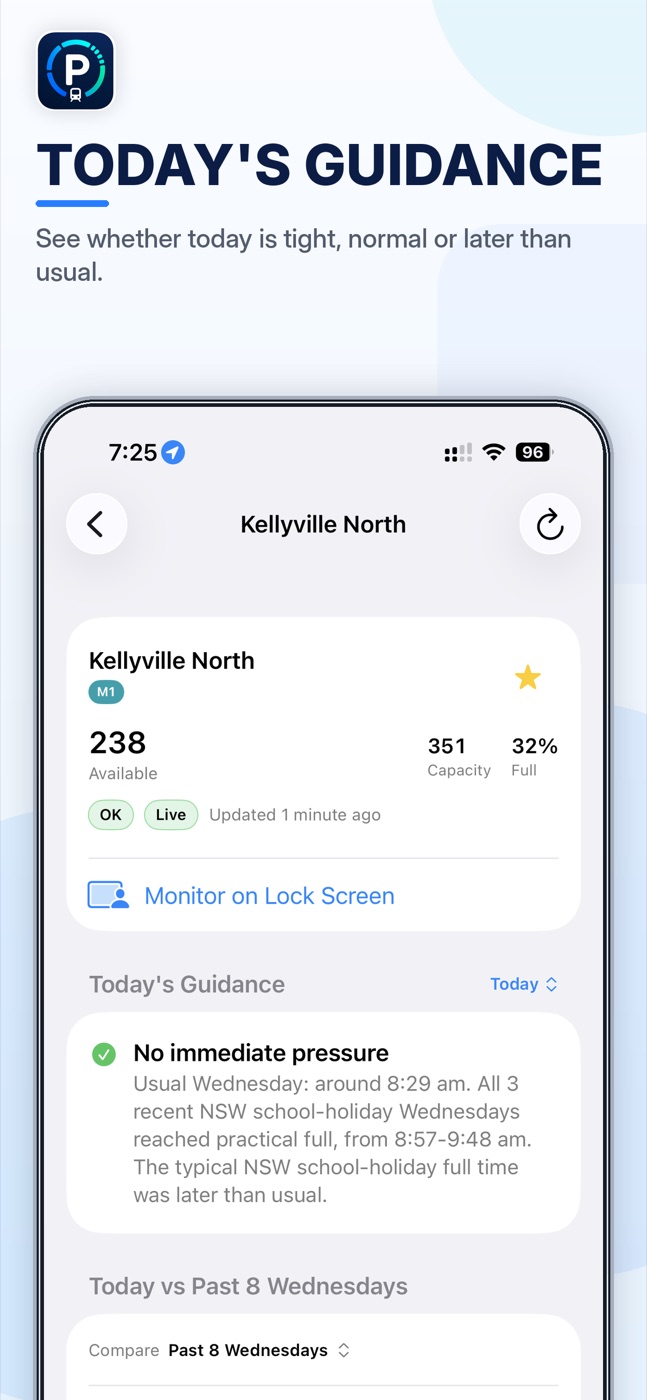
Today's Guidance compares the usual weekday pattern with current parking conditions. It does not assume rain gives you more time to arrive, which is consistent with this analysis.
Sources and disclosure
- Transport for NSW Open Data: Car Park API, the source of parking availability observations stored and analysed by ParkRide Planner.
- Open-Meteo Historical Weather API, the source of hourly historical precipitation reanalysis used for station locations.
- ParkRide Planner rain-analysis dataset, generated by a reproducible read-only script with zero database writes.
ParkRide Planner is an independent iPhone and Apple Watch app using publicly available Transport for NSW data. It is not affiliated with or endorsed by Transport for NSW.